
On Kenya's Swahili coast, residents of Ribe worked with public officials to turn a local problem into a major government investment

“The community, and I will repeat this for the millionth time,” declares Hashim Ndoro, Chairperson of the Ribe Community Initiative (RCI), “are now doing it themselves. They’re doing development themselves; they have organised themselves; they’re now receiving funding themselves.”
Established in March 2024, RCI is a community group from the village of Ribe in Kilifi County, Kenya, who have organised with the intention of formally becoming a community foundation. Their task is to address the social and infrastructural needs, challenges and opportunities the community faces – while ensuring that local residents lead the process.
RCI is part of a growing movement of community foundations along Kenya’s Swahili Coast, under umbrella programme the Swahili Coast Community Foundations Initiative (SCCFI), where local groups are organising to take greater ownership of their development priorities.
Co-financed by the Aga Khan Foundation (AKF) and the Charles Stewart Mott Foundation, SCCFI was established to harness the spirit of Harambee (“all pull together”) in Kenya and support community-driven development along the coast. Through the initiative, AKF works with emerging community foundations to strengthen local leadership, encourage community participation and help communities identify priorities, mobilise resources and engage constructively with government and other development partners – where the approach is designed to support long-term, locally led development rather than deliver projects on communities’ behalf.

“It was my dream to be a part of the solution to what goes on in our community,” says Ndoro. Now, through RCI, he explains, the community has a formal structure to lead its own development. “And one of the best things that has happened so far, is that the county government is listening to us.”
Nestled in the sandstone hills of Rabai Sub-county, near one of the region’s Sacred Kaya Forests, Ribe sits within sight of coastal urban growth. Despite this, and although major water infrastructure runs through the area to supply the city of Mombasa, Ribe has long been overlooked – with access to clean water one of the community’s most pressing challenges.
A prolonged drought has also worsened water shortages in the region, with the failure of recent seasonal rains leaving water pans dry, and forcing residents to contend with water shortages, food insecurity and the threat of livestock deaths.
For Ndoro and the members of RCI, these challenges became an opportunity to engage county authorities. “We were lucky enough that the water that flows to Mombasa runs close to our village – and we realised we can capitalise on this and contact the government to repair the pipe to Ribe.”
“And one of the best things that has happened so far, is that the county government is listening to us.”Hashim Ndoro, Chairperson of the Ribe Community Initiative
Because local government officials are also members of RCI, the group has been able to work closely with county authorities to advance its proposals. Mary Kuvuna, a member of RCI and Ribe’s Area Chief, explains that this collaboration helps to ensure that “water supplies for domestic purposes can be delivered to the community”.
After gathering input from the community and aligning their priorities, RCI formally wrote to the Kilifi government to request that repairs to one kilometre of broken water pipeline – the only connection between Ribe and the main water supply – be included in the next budget cycle.
The group’s process and direction reflect the aims of the SCCFI, where participation and the gathering of diverse community members – village chiefs, elders, local government and marginalised groups – is fundamental to community mobilisation and locally-led development.
Rather than relying solely on external support, the initiative promotes a model of co-investment and responsibility, where communities have a vested interest – contributing resources, ideas and leadership – while engaging government and other partners. As one SCCFI participant put it, “there’s no way you can lick an empty hand” – a reminder that organised communities are better positioned to attract support and mobilise resources.
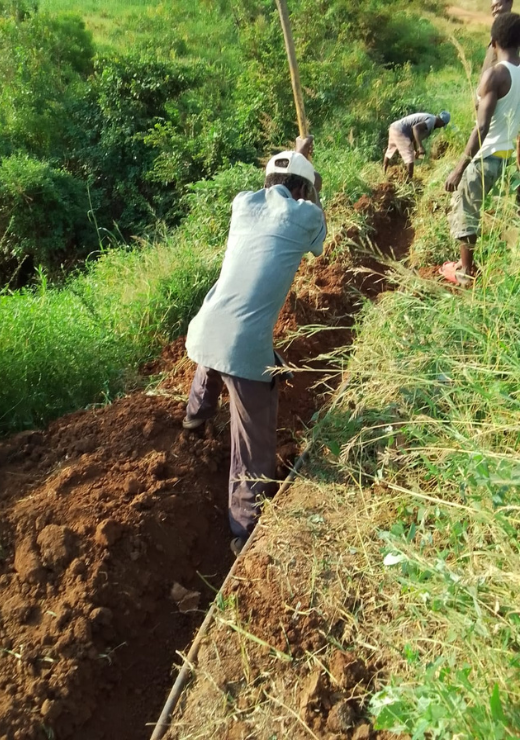
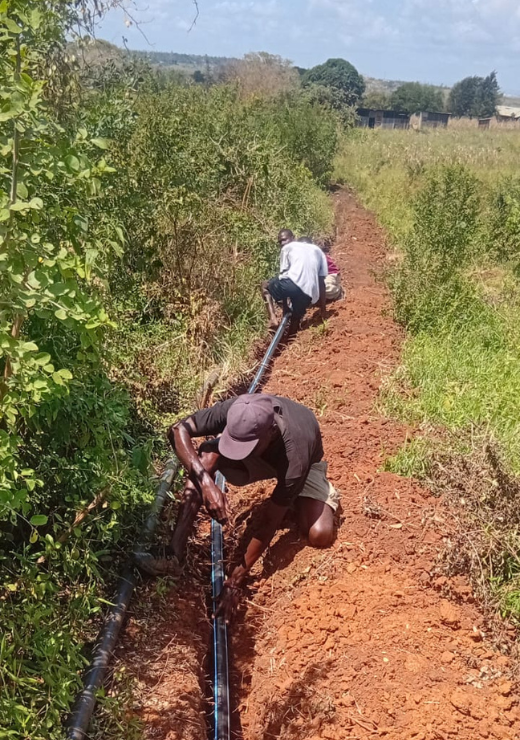
County government responded to RCI’s letter; they would supply Ribe with four kilometres of new pipeline, as opposed to repairing the broken kilometre RCI had originally raised. They would also fit a 5000-litre water tank to the new pipeline, to serve as a backup for times when water may not flow through the pipe.
As a further result of this engagement, the county committed a broader package of support. In addition to the new pipeline and water tank, the government confirmed that Ribe would be included in the 2026 financial budget, with 55 million Kenyan shillings (about £316,000) allocated for four boreholes, two water pans, a large storage tank and additional pipelines.
“The county government of Kilifi responded positively because repairing the water pipeline aligns with the County Integrated Development Plan (CIDP), which prioritises water infrastructure and improved service delivery,” says Mariam Mohamed, AKF’s Project Coordinator for SCCFI.

“The goodwill of officials to support an organised, community-led initiative like RCI also contributed to the response,” Mohamed continues. “By acting, the county fulfilled its mandate while demonstrating commitment to partnership, responsive service delivery, and sustainable water development.”
Since installing the new pipeline and water tank, around 600 households in Ribe – about 3000 people – now have access to clean water.
“Through the water pipeline project,” Kuvuna explains, “families that previously struggled to access clean water are now experiencing relief, dignity and improved livelihoods,” with less time spent collecting water and greater reliability for daily needs.
In bringing together residents, local leaders and government representatives, RCI has created a space where decisions about the development of their community are discussed openly and acted upon collectively.
This has meant not only identifying projects that benefit Ribe, but also finding ways to mobilise support – from local contributions to public investment. As Ndoro puts it, “the resources are there, we must learn how to tap into them”.
This article was originally published by The East African



Support our work Your donations are helping us build a future where we all thrive together.